White FRP Gel Coats and Epoxy Casting: Wetting, Print-Through and Real Thickness
SEP-White 50% TiO2 paste for white FRP gel coats and epoxy castings. Wetting, print-through, hiding at real thickness, exotherm in thick sections and polishability.
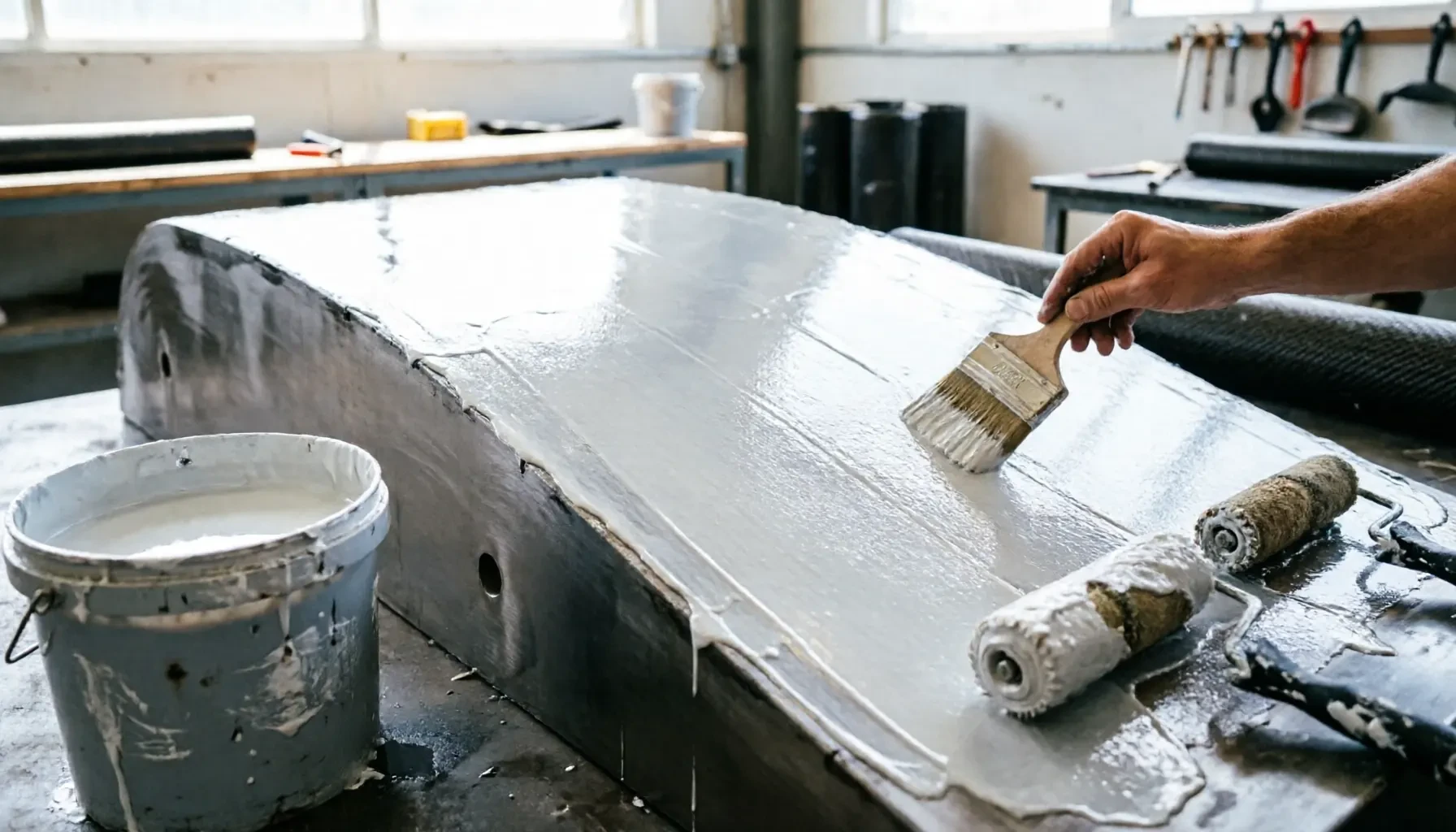
White composite surfaces are less forgiving than coloured ones. Any glass strand print-through, resin-rich patch, pinhole or sanding mark reads as a grey shadow on white, and the eye detects it long before an instrument would. That makes white work a process question as much as a pigment question.
1. Where white gel coats and castings are used
- Glass-fibre and carbon-fibre cosmetic panels, covers and housings
- White epoxy castings for electrical, instrument and machine components
- Gel coats on moulds and patterns where surface defects must be visible
- White base layers under translucent or decorative top layers
2. Wetting is the first variable, not hiding
At 50% rutile TiO2, SEP-White introduces a high volume of fine inorganic solid. In a gel coat or casting resin, the immediate effects are on wetting of reinforcement and on air release. If the paste is added without adequate dispersion, the result is localised white variation and trapped air rather than a uniform surface. Stir at 500–800 rpm until uniform, with a brief high-speed step at 1,000–1,500 rpm to complete colour development. Where the host system permits, degas before pouring. In hand lay-up and spray-up, confirm that the paste does not shorten the wet-out window on the reinforcement.
3. Print-through is a film-build problem
A white gel coat hides strand pattern through a combination of opacity and thickness. Reduce thickness to save material and the pattern returns. Test hiding at the minimum film build the process can hold, over the actual laminate, rather than on a flat plaque.
| Condition | Typical symptom | First control to check |
|---|---|---|
| Gel coat too thin | Strand print-through, grey shadowing | Film build and spray/lay-up uniformity |
| Paste under-dispersed | Mottling, local loss of opacity | Mix time, shear step, pre-homogenising the container |
| Air entrainment | Pinholes revealed after sanding and polishing | Mixing speed, degassing, pour technique |
4. Thick castings concentrate heat
In casting, white surfaces hide the early signs of an overheating centre until cracks or shrinkage voids have already formed. High pigment volume also raises mixed viscosity, which slows bubble rise. For thick sections, control pour mass per stage, ambient temperature and hardener selection, and follow the resin supplier's approved pour depth rather than assuming a universal safe thickness.
5. Heat resistance and appearance stability
The cured film is rated to 300 °C and the pigment system to grade 8 light fastness with excellent weathering resistance. For composite parts, those values support high-temperature cure and short-term thermal exposure, but they do not make the epoxy matrix UV-stable. Exterior white parts need an appropriate topcoat, and gloss retention must be verified on the finished article.
6. Cost logic in composite production
Gel coat and casting paste consumption in composite shops is large and continuous. At an equal hiding target, a 50% paste delivers roughly 1.67 times the titanium dioxide per kilogram of a 30% paste, so less mass is consumed per part. Where a shop runs white parts as a standard product line, that difference is a direct material cost reduction rather than a theoretical benefit.
7. Limits
SEP-White does not provide structural reinforcement, flame retardancy, thermal or electrical conductivity, or UV stabilization. White appearance does not certify a fire classification or a marine approval. Those properties belong to the complete laminate and its certification programme. Product page: SEP-White Epoxy White. Composite overview: FRP pultrusion.