White Epoxy Potting: Identification, Opacity and the TiO2 Penalty
SEP-White for white epoxy potting and encapsulation. Identification colour, component concealment, TiO2 effects on viscosity and dielectric behaviour, and phr screening levels.
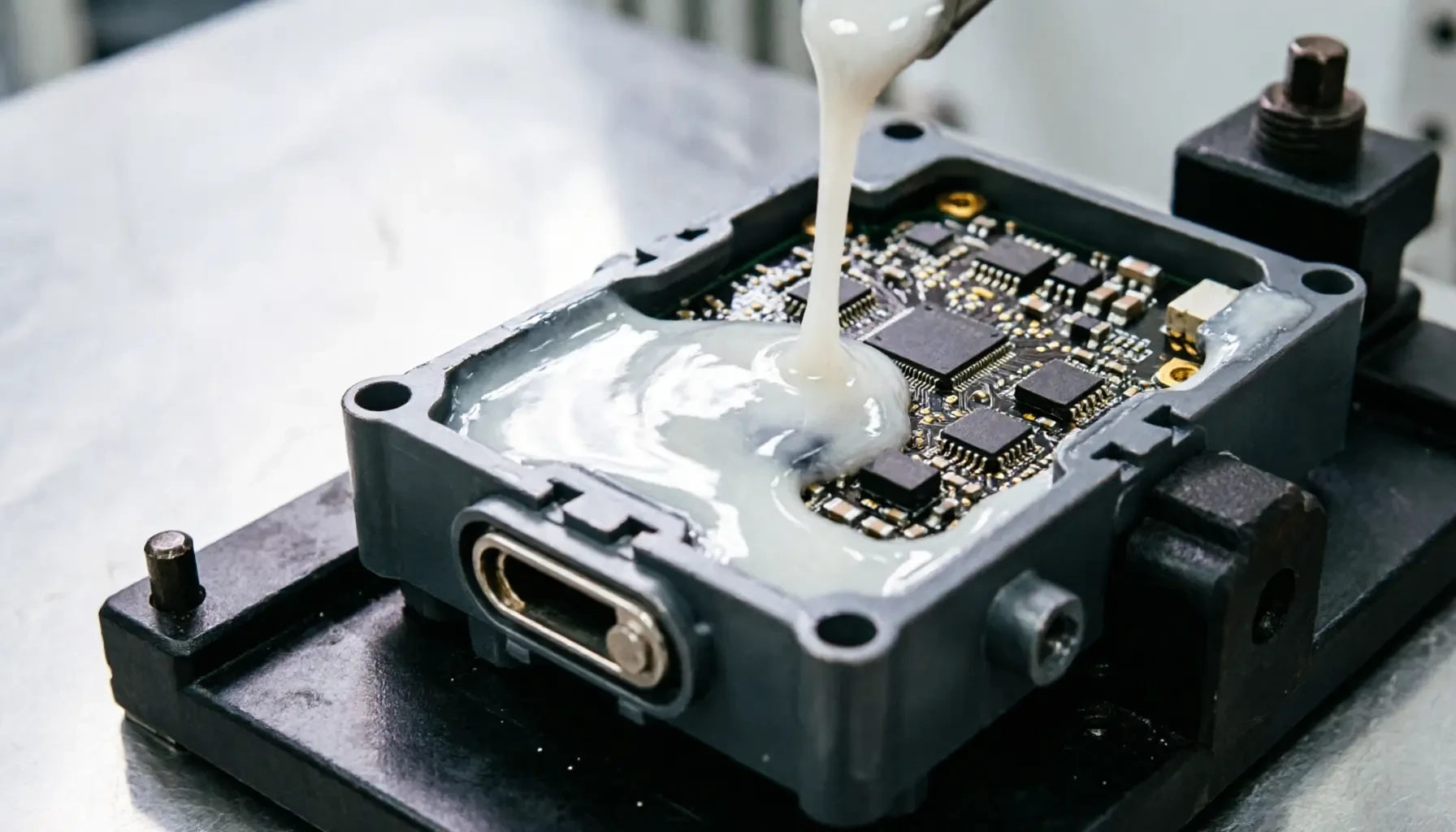
Most potting discussion focuses on black, because black hides. White potting is specified for a different set of reasons: product identification, inspection of the cured body, contrast against a dark PCB, brand-level appearance, and in some assemblies a deliberate optical function. Each of those reasons brings a constraint that a black compound does not have.
1. What white potting is actually asked to do
- Make the encapsulated body identifiable by product family, revision or customer
- Allow visual inspection of voids, flow marks and fill completeness against a dark board
- Provide an opaque, uniform exterior on modules that are visible to the end user
- Serve as a reflective or contrast layer where the assembly has an optical function
2. The TiO2 penalty is real
Rutile titanium dioxide is a high-refractive-index inorganic pigment. At 50% concentration in the paste, a meaningful volume of solid is introduced into the compound. Three consequences follow.
| Effect | What changes | Where to check |
|---|---|---|
| Viscosity and flow | Mixed viscosity rises; fill and wetting of dense assemblies slow down | After paste addition and after hardener addition, at application temperature |
| Dielectric behaviour | Inorganic filler alters the effective dielectric properties of the compound | Volume resistivity, dielectric constant and loss on the cured compound |
| Thermal path | Filler loading changes thermal conductivity relative to an unfilled system | Measured thermal conductivity of the complete compound, not of the paste |
None of these are defects. They are consequences that must be qualified. A white potting compound is a different material from the black version of the same base resin, and the qualification data cannot be transferred between them.
3. Screening levels for potting
| SEP-White on Part A | Typical outcome | Measure before approval |
|---|---|---|
| 1–3 phr | Light tint, partial opacity | Mixed viscosity, gel time, cured appearance |
| 3–5 phr | Solid white body at normal wall thickness | Opacity at thinnest wall, voids, exotherm, hardness |
| 5–8 phr | High-opacity white, higher viscosity | Fill completeness in dense assemblies, dielectric data, thermal data |
4. Process discipline
Add SEP-White to the resin component before hardener, stir at 500–800 rpm until uniform, and pre-homogenise the container if settlement is observed. In potting, the failure mode that matters most is incomplete fill around tall components, and that risk rises with viscosity. Degas where the process allows and verify fill on a sectioned sample, not only on the surface.
5. Where white is the wrong choice
White potting is not a substitute for optical-grade encapsulants in imaging paths, and it is not a low-outgassing or space-qualified system. It does not provide flame retardancy, thermal conductivity or EMI shielding by itself. Where the assembly must remain visually neutral or where stray light must be minimized, black is usually the correct selection.
6. Cost note for high-volume assemblers
At equal opacity, a 50% paste requires less mass than a diluted white paste, which reduces drum handling and inventory in high-throughput lines. The saving must be weighed against the viscosity increase, because a slower fill cycle can cost more than the pigment saved. Run the trial on the actual dispensing equipment before committing. Product page: SEP-White Epoxy White. Potting overview: epoxy potting and casting.