White Epoxy Floors, Self-Levelling Systems and Mortars: Hiding Power at Real Film Build
SEP-White 50% rutile TiO2 epoxy paste for white self-levelling floors and epoxy mortars. Hiding at real film build, addition levels in phr and the cost logic of high pigment load.
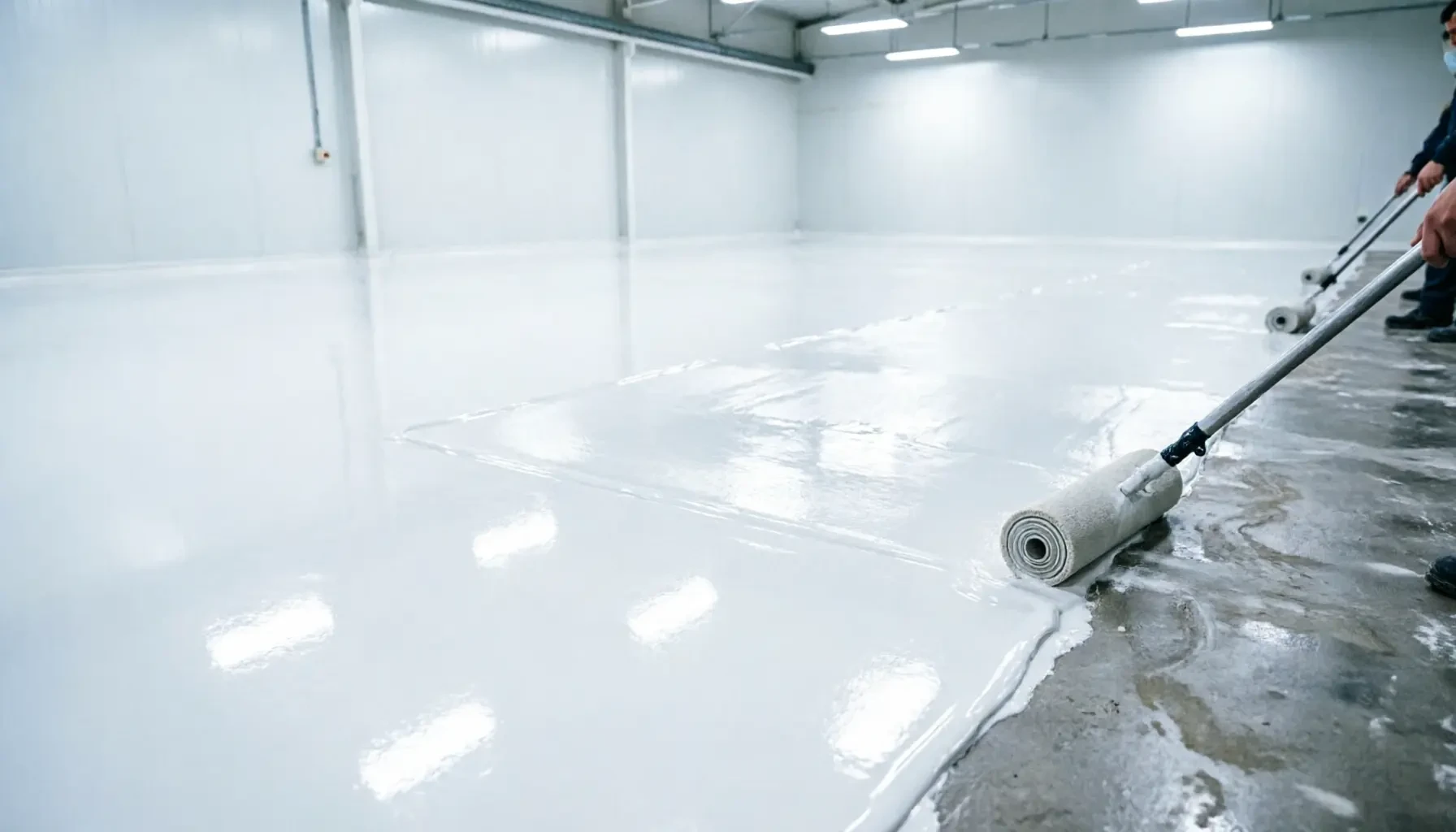
White and light-toned epoxy floors are specified where the floor is part of the visual standard rather than only a wear surface: clean production areas, pharmaceutical and food-adjacent zones, electronics assembly, laboratories, showrooms and medical facilities. The engineering question is not whether the floor looks white on a sample plaque, but whether it still hides the substrate at the film build that will actually be installed.
1. Why film build decides the answer
A 3 mm casting coupon is effectively opaque at almost any pigment load. A 300 μm self-levelling coat over a grey concrete slab is a different optical problem. Judging hiding from a thick coupon is the most common way a white floor project ends up needing a second coat. SEP-White carries 50% rutile titanium dioxide in a solvent-free epoxy carrier. That concentration means the formulator reaches a target hiding level with a lower mass of paste than would be required with a diluted white product — the relevant comparison for floor work, where paste consumption is measured in tonnes rather than kilograms.
2. Addition levels in the units floor formulators actually use
| Target | SEP-White on Part A | Practical comment |
|---|---|---|
| Light grey or pastel floor | 1–3 phr | Usually combined with a small amount of chromatic paste |
| Mid-tone floor | 3–5 phr | Common range for tinted self-levelling systems |
| Full white floor | 5–8 phr | Where the white itself carries the appearance |
| White over iron oxide or high-opacity requirement | 2–10 phr | Highest loading when opacity governs the specification |
Values are parts per hundred of the resin component. Confirm against the actual primer tone, slab moisture and application thickness, because a dark or damp substrate raises the required hiding.
3. What changes in the mortar and self-levelling mix
Titanium dioxide at 50% in the paste introduces a real pigment volume into the formulation. In a filled mortar with silica sand, that shifts the binder-to-filler balance and can move rheology, open time and surface finish. Check viscosity after paste addition, levelling behaviour at the specified thickness, and whether the paste alters the sand settling pattern. The paste is solvent-free and non-volatile above 98%, so it does not introduce a solvent that must be evaporated before the next coat. That matters in multi-layer flooring where recoat windows are tight.
4. Three failure modes worth budgeting for
- Yellowing: the pigment system is rated grade 8 light fastness, but aromatic epoxy matrices yellow under UV. Sunlit floors need a UV-stable topcoat, and that cost belongs in the quotation.
- Dirt visibility: a white floor shows tyre marks, dust and scratches earlier than a mid-grey floor. Specify cleaning regime and wear coat accordingly.
- Patch colour mismatch: repairs on a white floor are visually obvious. Keep a retained sample of the approved batch for future matching.
5. Cost per square metre, not cost per kilogram
The commercial case for a 50% paste is arithmetic: at a fixed target hiding level, a higher-concentration paste requires proportionally less mass. Where a diluted 30% paste needs roughly 8 phr, the same delivered TiO2 is reached with about 5 phr of a 50% paste. On a large floor project that difference dominates the raw-material line, which is why high-volume users should evaluate paste on delivered hiding rather than on price per drum.
6. Boundaries
SEP-White is a colour component, not a flooring system. It provides no anti-slip texture, no ESD performance, no chemical-resistance guarantee and no flame retardancy. Those properties belong to the complete floor construction and must be tested on the finished system. Product page: SEP-White Epoxy White. Flooring overview: epoxy flooring.