White Epoxy in Sports Equipment and Outdoor Gear
SEP-White 50% TiO2 epoxy paste for white sports equipment, boards, paddles and outdoor gear. Wetting, print-through, UV limits and phr levels for composite lay-ups.
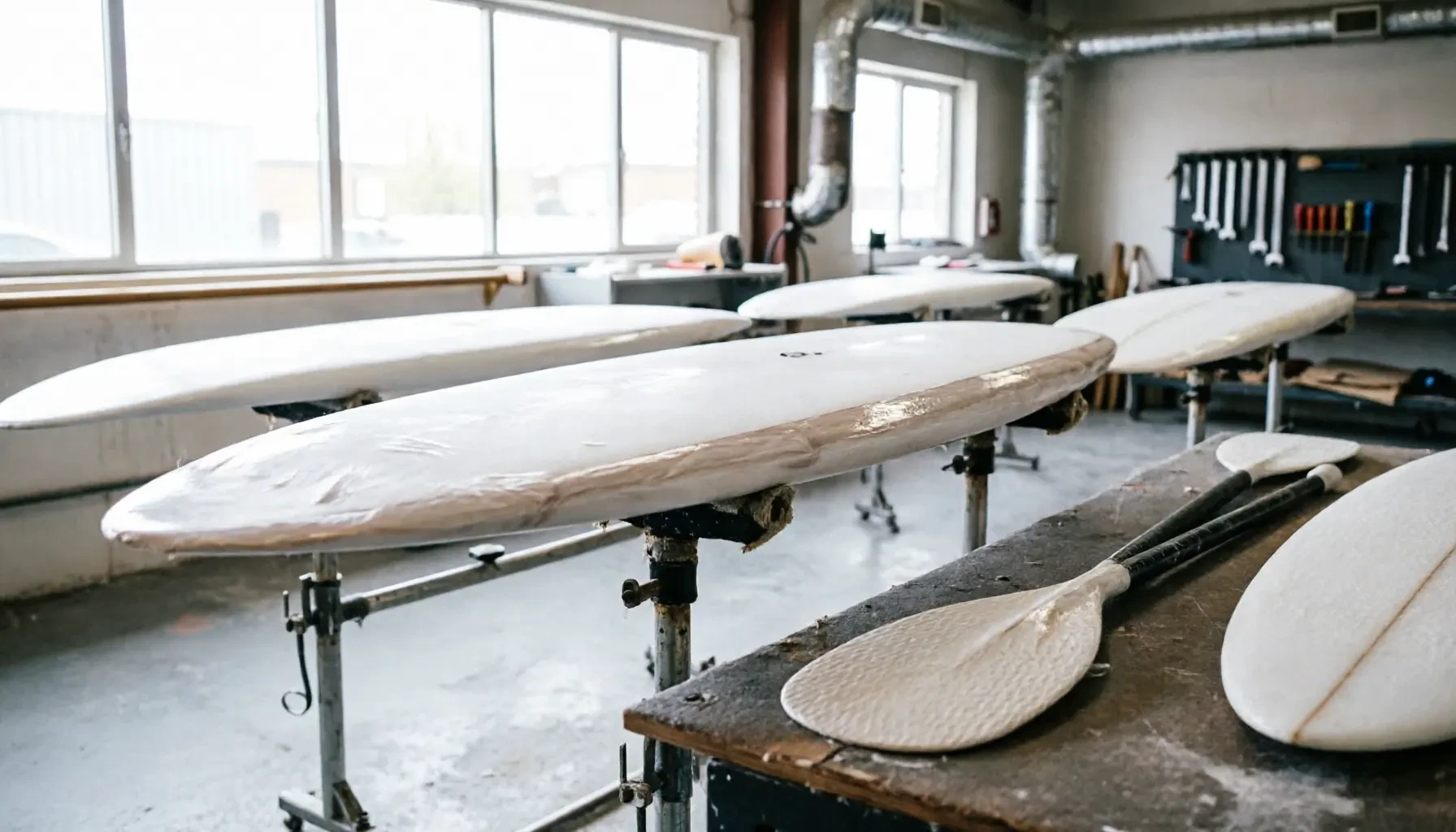
Sports equipment is one of the few composite markets where colour is a direct product feature rather than an industrial convention. A white board, a white paddle face or a white helmet shell is aesthetically specified, and it must survive sunlight, water, abrasion and repeated flexing. That makes the coating system, and the pigment inside it, part of the product's durability story.
1. Product categories involved
- Snowboards, skis and splitboards with white topsheets or base layers
- Stand-up paddles, surfboard elements and kiteboard components
- Bicycle frames and components with white cosmetic finishes
- Helmet shells, protective guards and water-sports hardware
- Fishing rods, reels and outdoor equipment housings
2. White on a flexing part is a coating problem
Boards and paddles flex. A coating that hides well but embrittles or cracks at the flex line fails in service, and a crack in a white surface is extremely visible. The pigment paste must therefore be evaluated not only on hiding but on its effect on coating flexibility through the curing system selected. SEP-White carries 50% rutile TiO2 in a solvent-free epoxy carrier. At higher loadings, the inorganic volume can raise modulus and reduce elongation of the cured film. Where the host system is a flexible epoxy or a toughened formulation, confirm elongation and adhesion after flex cycling rather than relying on a flat-panel pull test.
3. Print-through and wetting on reinforcement
| Condition | Symptom on a white part | Control |
|---|---|---|
| Thin gel coat | Weave or strand pattern visible through white | Film build and lay-up uniformity |
| Poor wet-out | Local grey patches, loss of whiteness | Dispersion time, resin wetting, reinforcement finish |
| Air entrainment | Pinholes revealed after sanding | Mix speed, degassing, pour technique |
4. UV is the dominant lifetime risk outdoors
The pigment system is rated grade 8 light fastness with excellent weathering resistance. That protects the pigment, not the matrix. Aromatic epoxy yellows and chalks under sustained UV, and outdoor sports equipment sees more UV per season than most industrial parts see in a lifetime. A UV-stable topcoat or a dedicated clear system is therefore part of the specification, not an optional extra.
5. Addition levels for composite work
| SEP-White on Part A | Typical use | Check |
|---|---|---|
| 2–3 phr | Light tint or pastel topsheet | Hiding at minimum film build, flex behaviour |
| 4–6 phr | Standard opaque white topsheet | Print-through, adhesion after flex cycling, UV topcoat bond |
| 7–8 phr | High-opacity white, thin sections | Viscosity, wet-out, elongation of the cured film |
6. Cost note
Sports equipment production is seasonal and volume-driven. At equal hiding, the delivered TiO2 per kilogram from a 50% paste is substantially higher than from a diluted white paste, which reduces paste mass per unit and simplifies inventory ahead of a production season. Where a factory runs white as a standard colourway, this is a recurring material saving.
7. Limits
SEP-White does not provide impact modification, UV stabilization, water resistance or abrasion resistance by itself, and white appearance does not certify any product-safety standard. Helmet and protective equipment claims belong to the certified finished product, never to the coating or the paste. Product page: SEP-White Epoxy White.