White Epoxy in Solid-Surface Countertops, Vanity Tops and Laboratory Benches
SEP-White 50% TiO2 epoxy paste for white solid-surface countertops, vanity tops and laboratory benches. Hiding, yellowing control, heat resistance and phr levels.
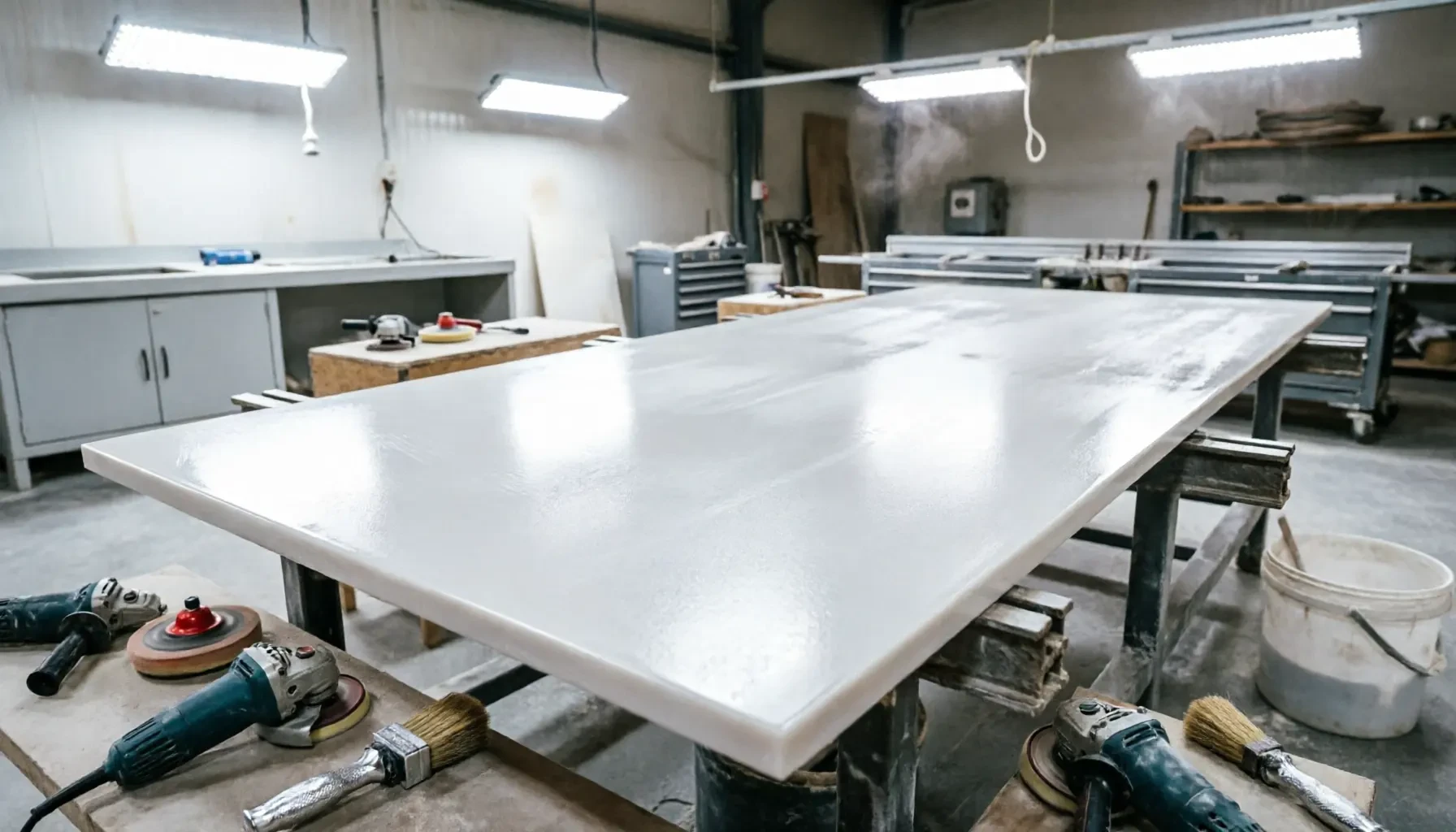
White dominates solid-surface work for reasons that have little to do with fashion. A white surface makes contamination visible, allows consistent colour matching across separately fabricated pieces, and photographs predictably in catalogues. In laboratories and medical-adjacent spaces, the visual standard itself is part of the specification.
1. Where white epoxy systems are used
- Kitchen and bathroom vanity tops in mineral-filled epoxy or resin-mineral composites
- Laboratory benches and work surfaces where visible cleanliness matters
- Commercial countertops in food preparation and display areas
- Washroom and sanitary panels requiring joint-free white surfaces
2. The colour-matching problem across pieces
A countertop is rarely one piece. A run may include a sink surround, a backsplash, an island and a repair insert, fabricated days or weeks apart. If the white drifts between batches, the joint becomes visible and the job is rejected. High pigment concentration helps here: a 50% paste reaches hiding with less mass, so the batch-to-batch addition variation has a smaller relative effect on the final tone.
3. Addition levels and filler balance
| Target | SEP-White on Part A | Comment |
|---|---|---|
| Off-white or warm white | 1–3 phr | Often combined with a trace of yellow or black paste to set the tone |
| Standard white | 3–5 phr | Typical for mineral-filled countertop systems |
| High-opacity white | 5–8 phr | Where a thin section must still hide the substrate |
In mineral-filled composites, the paste competes with the mineral filler for binder. Increasing paste load therefore changes both colour and mechanical balance. Confirm impact strength, hardness and thermal expansion on the finished slab, not on a small coupon.
4. Yellowing is the main lifetime risk
The pigment system is rated grade 8 light fastness with excellent weathering resistance, and the cured film is rated to 300 °C. Those properties protect the pigment. They do not prevent the epoxy matrix from yellowing under UV or from discolouring under repeated hot-water exposure. Kitchen and vanity applications need an appropriate topcoat or a UV-stable resin selection, and the yellowing claim must be verified on the finished product.
5. Heat and chemical exposure
A 300 °C pigment rating is frequently misread as a service-temperature rating. A countertop that receives a hot pan is a short-term thermal event; a bench that sees solvents and reagents is a chemical-exposure question. Both must be qualified on the cured composite. SEP-White adds no chemical resistance of its own.
6. Cost in volume production
Countertop fabricators consume white paste continuously and in large quantities. At an equal hiding target, the delivered titanium dioxide per kilogram of a 50% paste is roughly 1.67 times that of a 30% paste, so a shop running standard white lines consumes materially less paste per square metre. The saving compounds with inventory and handling reductions.
7. Limits
SEP-White does not provide antibacterial performance, food-contact compliance, flame retardancy or scratch resistance by itself. Claims for hygiene, contact safety or fire classification belong to the complete finished article and its test programme. Product page: SEP-White Epoxy White. Construction overview: epoxy construction.