Light-Coloured Epoxy for Tooling, Fixtures and Checking Aids
SEP-White for light-coloured epoxy tooling, fixtures, checking aids and pattern equipment. Why white improves defect visibility, and what to verify in dimensional stability.
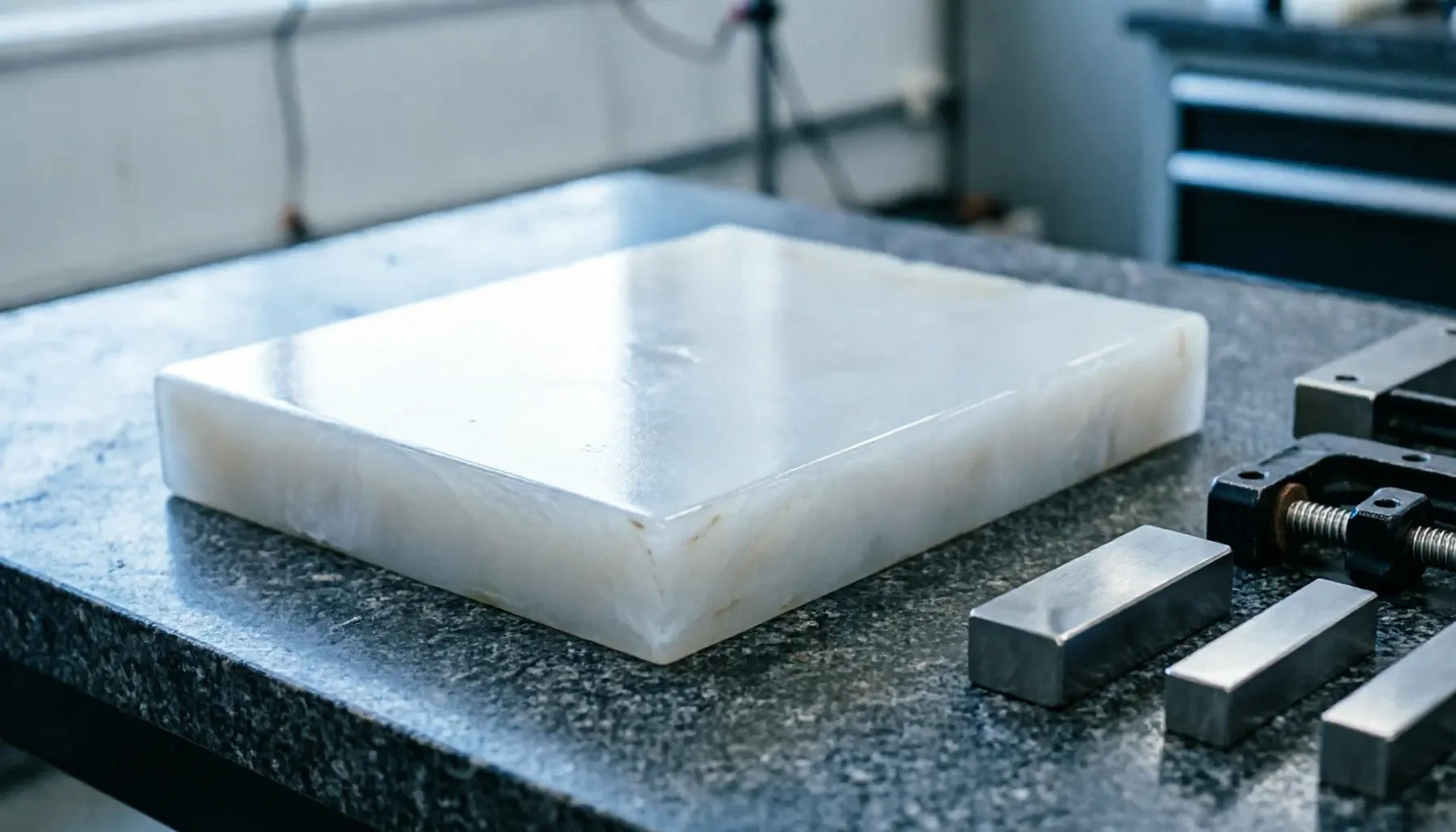
Most tooling discussion assumes dark colours, because dark surfaces hide contamination and are conventional. Light tooling is specified for the opposite reason: on a white fixture or checking aid, a scratch, a burr, a stain or a dimensional witness mark is immediately visible. In inspection work, visibility is the function.
1. Where light-coloured tooling earns its place
- Checking fixtures and gauges where surface defects must be seen at a glance
- Pattern equipment and master models used for visual surface assessment
- Assembly jigs in clean environments where contamination must be detected early
- Reference blocks and comparators used to demonstrate surface condition
2. White turns the surface into an inspection instrument
A dark tool surface absorbs the visual evidence of wear. A white surface reflects it. For a checking fixture, that is the entire value proposition: the operator sees a witness mark without needing controlled lighting or magnification. The trade-off is maintenance. White tooling shows handling marks, release-agent residue and resin staining earlier, so the cleaning regime has to be defined alongside the colour choice. This is a real operational cost and should be quoted, not discovered later.
3. Dimensional stability matters more than colour
A tooling laminate is judged on dimensional behaviour, and the pigment paste participates in that. At 50% titanium dioxide, SEP-White introduces a significant inorganic volume into the resin system, which affects shrinkage, exotherm and cure contraction.
| Property | Why the paste matters | How to qualify |
|---|---|---|
| Cure shrinkage | Inorganic filler volume reduces volumetric contraction relative to unfilled resin | Measure on the actual tool geometry, after full post-cure |
| Exotherm in thick sections | Tooling blocks are often thick; heat concentration causes distortion | Thermocouple in the real block, staged casting |
| Thermal behaviour in service | Filler loading shifts expansion relative to the unfilled system | Compare at the service temperature, not at room temperature only |
4. Heat resistance: short-term property, not a service rating
The cured film is rated to 300 °C. Tooling that sees elevated temperature during post-cure or during a moulding cycle should be evaluated on the complete laminate at the actual service condition. A pigment rating does not transfer into a continuous tooling-temperature approval, and tool life depends on the host resin's glass transition temperature and cycle history.
5. Process notes
Add SEP-White to the resin component before hardener, disperse at 500–800 rpm with a brief high-shear step, and degas where the section is thick. In pattern work, verify that the paste does not change the replication fidelity of fine surface detail. Where the tool will be machined after cure, confirm that the dispersion state is uniform so that machined surfaces do not reveal mottling.
6. Limits
SEP-White provides no wear resistance, no release properties, no dimensional certification and no thermal conductivity. A light colour does not certify cleanliness or a cleanroom classification. The tool's fitness for inspection work must be established by its own dimensional and surface assessment. Product page: SEP-White Epoxy White.