SEP-955 in Violet Potting, Electronic Encapsulation and Epoxy Adhesives
SEP-955 violet paste in potting, encapsulation and epoxy adhesives: 1 to 4 phr dosage, void visibility, dielectric caution, dispersion and exotherm limits.
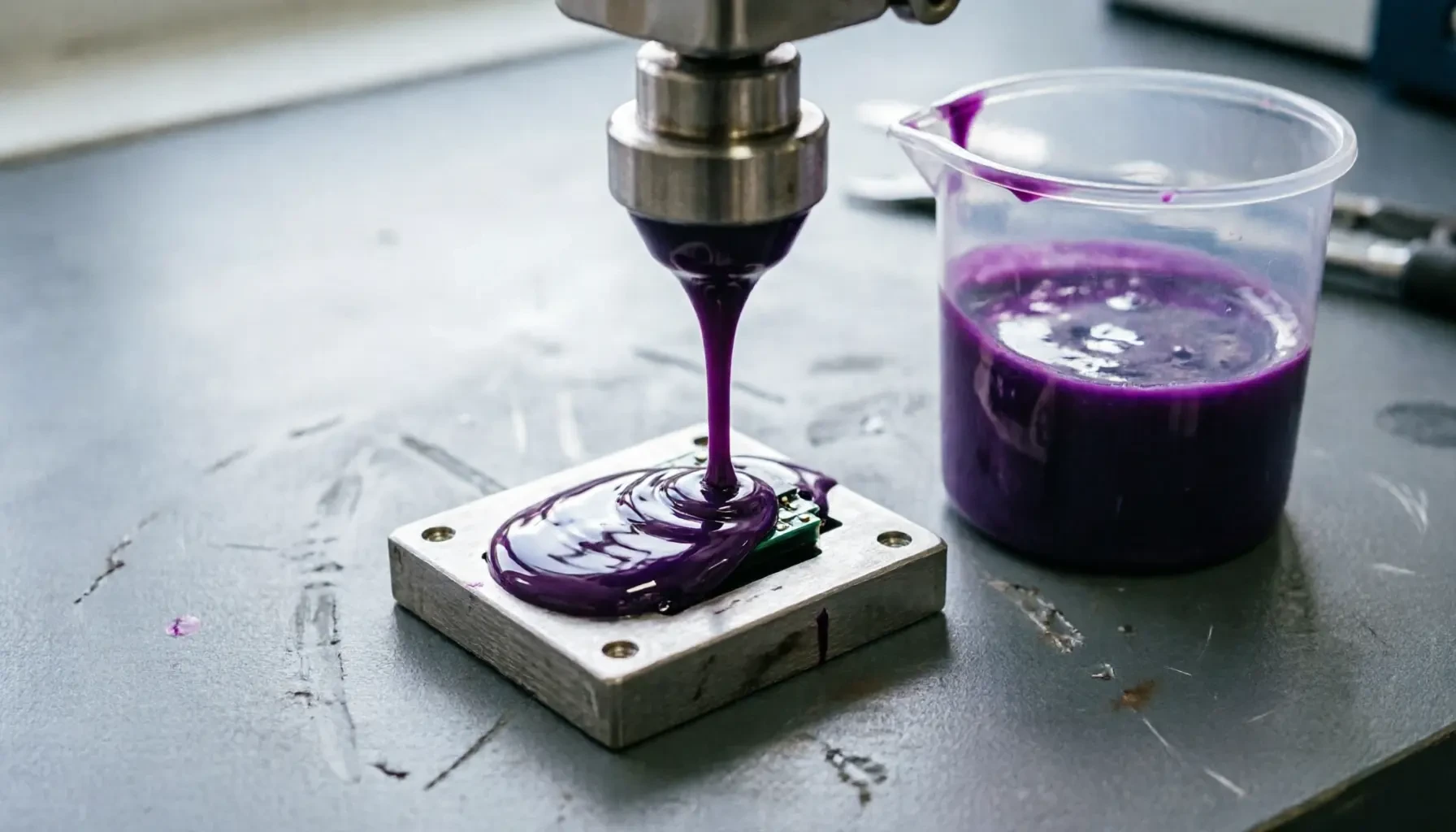
SEP-955 colours potting compounds and epoxy adhesives at roughly 1 to 4 phr, usually as an identification or appearance aid rather than as a performance additive. The paste is 15 percent Pigment Violet 23 in an epoxy carrier with no added solvent. Any effect on electrical, thermal or mechanical behaviour has to be measured on the complete cured compound, because the pigment is only one part of the system.
What SEP-955 is inside a potting formula
| Item | Value | Why it matters in potting |
|---|---|---|
| Colour body | C.I. Pigment Violet 23 (C.I. 51319) | Provides the violet for part identification |
| Loading | 15% by weight in the paste | Sets how much paste is needed per 100 g of resin |
| Vehicle | DGEBA epoxy resin plus reactive diluent | Cures into the matrix instead of evaporating |
| Grind | 3–5 μm | Limits coarse particles in thin cavities |
| Density | 1.17 g/mL at 25 °C | Used to convert phr into weighed grams |
| Added solvent | None | Nothing has to escape from a sealed unit |
| Cured-film heat resistance | 250 °C | Film property, not a service temperature |
| Pack size | 20 kg net plastic pail | Matches typical production batch sizes |
Because the carrier is epoxy, the paste participates in cure instead of evaporating. That matters in a sealed potting cavity where a solvent would have no route out. It also means the paste slightly changes the resin-to-hardener balance, which is why dosage should stay low and be included in the formulation record.
Potting and encapsulation
Colour in potting is usually functional: it identifies a product variant, separates revisions on a line, or makes voids and flow fronts easier to see during inspection. At 1 to 3 phr the violet is visible without dominating the unit; at 3 to 4 phr it reads as a solid body colour through a thin wall. Voids show up well against violet because bubbles scatter light differently from the surrounding resin. That is a visual aid, not a quality test: radiography, sectioning or electrical testing still decide whether an encapsulation is acceptable. Dielectric behaviour belongs to the complete compound. Filled systems, filler loading, cure schedule and moisture all influence insulation resistance more than a small addition of colour paste, but a heavily pigmented mix can change viscosity and flow, so check the fill and the cured properties after the colour is added.
Epoxy adhesives and sealants
In adhesives the bond line is thin, often 0.1 to 0.5 mm, and a thin film of violet reads lighter than the same mix in a casting. At 1 to 3 phr the colour is enough to identify a bead, confirm coverage on a substrate, or match a visible joint on a violet assembly. Pigment loading affects rheology more than strength at these levels. A paste thickened for a non-sag bead can become stiffer when colour is added, so recheck the application viscosity and the open time. Adhesion after ageing, peel strength and shear strength should be confirmed on the production formulation rather than assumed from the neat resin.
Dispersion and cure schedule
- Weigh the paste on Part A, using mass rather than volume, and record the batch.
- Disperse into the resin until the colour is uniform before the hardener goes in.
- Avoid solvent as a dispersion aid; it has nowhere to go in a sealed cavity.
- De-gas or vacuum the mix if void-free appearance is required.
- Cure to the resin supplier's schedule and check that the pigment has not settled in deep pots.
Pigment dispersion and drawdown comparison for larger batches are described in violet epoxy flooring, coatings and FRP composites.
Exotherm and mass limits
A large potting mass generates heat from the curing reaction, and violet gives no warning before the centre overheats. Deep or wide cavities should be filled in stages, or with a resin and hardener chosen for the mass, following the supplier's maximum pour depth. Colour stability under that heat is a property of the cured film, not a licence to exceed the resin's limits. Thick decorative pours raise the same issue in a different form; dioxazine violet casting for artware and river tables discusses depth, transparency and staged pouring for castings.
Limits
SEP-955 is not a flame retardant, a thermal conductor, a UV stabiliser or an electrical modifier. It does not certify a fire class, an insulation rating or a potted module's reliability. The 250 °C heat resistance refers to the cured film and grade 7–8 to light fastness; neither is a continuous service temperature or an outdoor warranty. Where a customer needs RoHS or EN 71 statements, the assessment applies to the final formulation and article, verified by the relevant test, not to the paste alone. Heavy-metal-free status of the colour body supports that assessment but does not replace it.
FAQ
How much SEP-955 is used in potting compounds?
Typically 1 to 3 phr on Part A, rising to about 4 phr when a stronger body colour is wanted through a thin wall. Confirm the effect on viscosity and cured properties at that loading.
Does the colour paste affect insulation resistance?
Not by design, and no such claim is made. Dielectric performance is a property of the complete cured compound, so it must be measured on the production formulation, especially in filled systems.
Can SEP-955 be used in a room-temperature-curing adhesive?
Compatibility depends on the specific epoxy and hardener. The paste is designed for epoxy systems and contains no added solvent; run a small trial to confirm cure, colour and bond strength before production. Product page: SEP-955 Dioxazine Violet Epoxy Pigment Paste. Series overview: epoxy color pastes.