Using SEP-955 in Violet Epoxy Flooring, Industrial Coatings and FRP Composites
SEP-955 dioxazine violet paste in floor coatings, industrial finishes and FRP laminates: dosage, hiding, dispersion, processing and the properties that still have to be qualified.
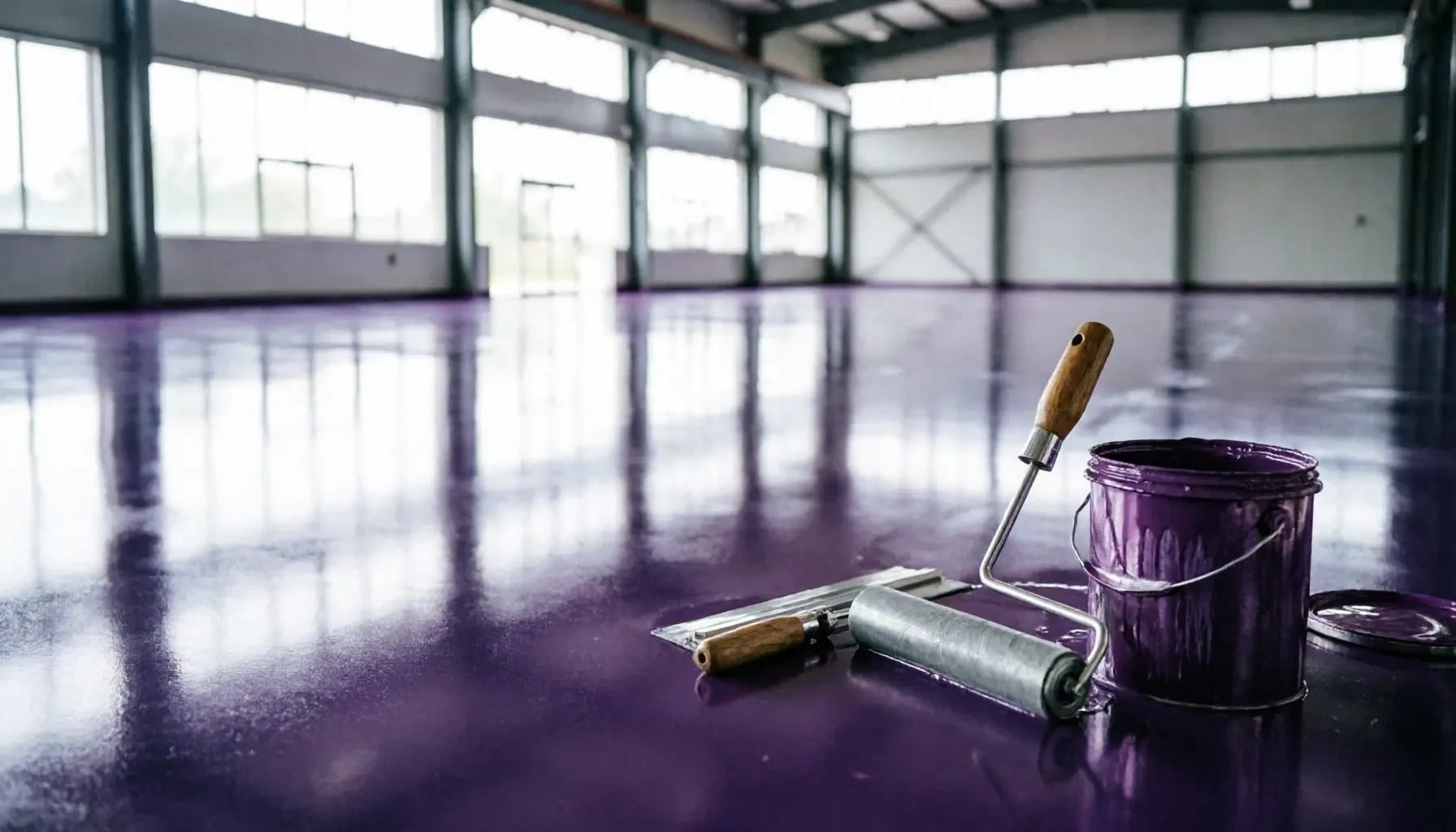
SEP-955 is a solvent-free violet paste carrying 15 percent Pigment Violet 23 in an epoxy carrier. In floor coatings and industrial finishes it is dosed at roughly 2 to 5 phr on the epoxy side to build a deep reddish violet at normal film builds, and in FRP laminates at 2 to 5 phr to colour the resin without altering the reinforcement schedule. The paste contributes colour only: wear, chemical resistance and weatherability belong to the resin system and have to be qualified on the finished coating.
What the grade contributes to a coating
| Property | SEP-955 |
|---|---|
| Pigment | C.I. Pigment Violet 23 (C.I. 51319) |
| Carrier | DGEBA epoxy resin with reactive diluent |
| Pigment content | 15% by weight |
| Fineness of grind | 3–5 μm |
| Density at 25 °C | 1.17 g/mL |
| Solvent content | None added; 100% solids |
| Heat resistance of cured film | 250 °C |
| Light fastness | Grade 7–8 (blue wool scale) |
| Standard packaging | 20 kg net plastic pail |
No solvent means the paste does not add volatile organic content to a low-VOC floor or coating formula, and no plasticiser means the carrier cures into the film rather than migrating out of it. For formulators working to a VOC limit, that simplifies the calculation, but it does not make the finished coating compliant on its own.
Flooring: film build, hiding and colour depth
A floor coating is thin compared with a casting. At 200 to 500 μm dry film thickness, 2 to 5 phr of SEP-955 gives a violet that stays slightly translucent and shows the substrate or flake pattern beneath. Increasing the loading deepens the shade and shortens the point at which the film looks flat and opaque. Large floors expose any inconsistency in dosage. Weigh the paste per batch rather than per drum, keep the same let-down resin and hardener, and keep a reference panel from each batch. A patch mixed at a different loading will read as a visible repair even when the formula is otherwise identical. Hiding is a separate decision from hue. Adding titanium dioxide white raises opacity and pushes the violet toward pastel, while white also lifts the lightness of the floor and changes slip perception. For a deep violet floor with good durability, many systems use a coloured base coat and a clear or lightly tinted wear layer rather than trying to reach opacity in a single coat.
Industrial coatings: gloss and batch consistency
Violet is often chosen for machinery, tanks, pipework and skids where standard colours are reserved for safety marking. At 1 to 3 phr it works as an identification colour on structural steel and equipment housings, and at 3 to 5 phr as a full body colour. Gloss and colour are linked through dispersion. A poorly dispersed paste leaves fine agglomerates that scatter light, so the film can look lighter and hazier than the same formula made with a well-dispersed batch. Disperse at controlled temperature, check a drawdown on glass, and compare against a retained reference rather than a photograph. Recoat windows, adhesion and chemical resistance remain properties of the coating system. SEP-955 neither improves nor deliberately degrades them, but a heavy pigment load can raise viscosity and affect spray or roller behaviour, so the application viscosity should be checked after the colour is added and not before.
FRP composites and laminates
In laminates the paste colours the resin that binds the reinforcement. At 2 to 5 phr the violet reads through the laminate and can be used to distinguish layers or product variants. The pigment does not replace gelcoat: a gelcoat builds the surface appearance, while the laminate colour is visible at cut edges and through translucent constructions. Wet-out is the practical constraint. Adding paste raises the viscosity of the resin mix slightly, and in thick stacks that can slow fabric wetting. Introduce the paste into the resin first, mix to a uniform colour, then add hardener, and confirm that the working life still suits the lay-up. Resin-rich areas will always read darker than resin-starved ones, regardless of pigment loading. No mechanical claim follows from the colour. Flexural, impact and interlaminar properties must be tested on laminates made with the production pigment loading, because the effect of any additive on a composite is a system effect.
Processing across the three applications
- Condition the paste to 20 to 25 °C before weighing; cold paste is stiff and disperses unevenly.
- Weigh by mass using the 1.17 g/mL density, and calculate dosage on Part A so the pigment ratio stays stable when mix ratios change.
- Add the paste to the epoxy resin and disperse before the hardener, keeping the batch below 50 °C.
- De-gas or vacuum the mix where film appearance matters; entrapped air shows as pinholes in a gloss finish.
- Keep a drawdown and a cured coupon from each production batch for comparison.
- Store remaining paste closed between 5 and 25 °C and use within the 24-month shelf life.
Limits and what to qualify
Exterior colour retention is the first limit. The pigment system is rated grade 7–8 light fastness and the cured film 250 °C, but aromatic epoxy still yellows and chalks under UV, so outdoor floors and coatings need a UV-stable topcoat and a test on the finished system. The 250 °C figure is a cured-film property, not a continuous service temperature. Chemical resistance, slip resistance, fire classification and abrasion performance are all properties of the complete floor or coating, tested to the standard that applies in the project's jurisdiction. SEP-955 provides no flame retardancy and certifies no fire class. Photographs of violet floors are appearance references, not colorimetric records.
FAQ
How much SEP-955 is needed in a floor coating?
Start at 2 to 4 phr on Part A for a medium violet and move toward 5 phr for a deeper shade. Thin films read lighter than thick ones, so confirm the colour on a panel at the specified film build.
Does SEP-955 change coating hardness or chemical resistance?
No such effect is claimed. Hardness and chemical resistance come from the resin and hardener; test the finished formulation if the pigment loading is high or the service is aggressive.
Can SEP-955 be used in a solventborne coating?
The carrier is an epoxy resin and the paste contains no added solvent, so it is designed for solvent-free and high-solids epoxy systems. Compatibility with a solventborne binder should be checked in a laboratory trial before production. Related reading: dioxazine violet casting for artware and river tables covers depth and transparency in thick decorative pours, and violet potting, encapsulation and epoxy adhesives covers colour used as an identification aid in potting and bonding. Product page: SEP-955 Dioxazine Violet Epoxy Pigment Paste. Series overview: epoxy color pastes.