Flooring Black: Jetness Is Not Conductivity
A deep black floor and a dissipative floor are two different specifications. Carbon black can deliver both, but not from the same loading or the same grade.
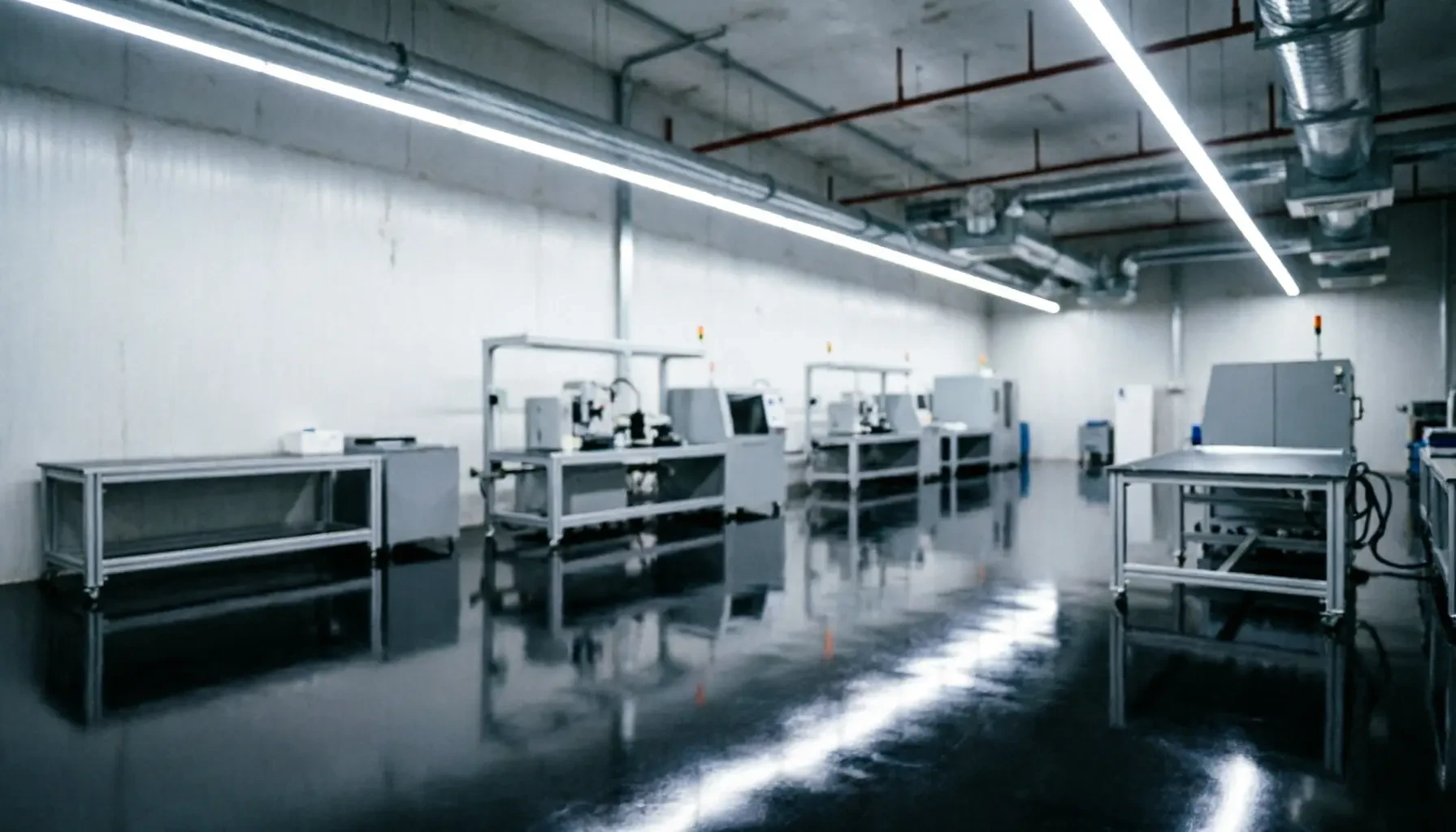
Black epoxy flooring is specified for two unrelated reasons: appearance, and static control. The two specifications are often written on the same drawing, and that is where confusion starts. A jet black coating is not automatically conductive, and a conductive coating is not automatically jet black.
Two Different Specifications
Jetness is an optical property. It depends on how completely the coating absorbs visible light, which a fine carbon black at a few percent achieves. Conductivity is an electrical property. It depends on a continuous network of conductive particles touching each other, which requires a much higher loading and a carbon black with the right structure.
| Specification | Property | Typical loading |
|---|---|---|
| Jet black appearance | Light absorption, hiding | 3–8% paste |
| Static dissipative | Surface resistance 10^6–10^9 Ω | 10–20% conductive carbon |
| Conductive | Surface resistance below 10^6 Ω | 20%+ conductive carbon |
A 15 percent pigment paste in an epoxy floor coating sits in the appearance range. It gives a deep, even black at normal film builds and does not, by itself, provide a dissipative surface.
Jetness and Hiding at Film Build
Floor coatings are thin relative to a casting, typically 200 to 500 microns per coat. Hiding at that thickness depends on pigment content and dispersion, not on the total solids of the system.
| Film build | What to expect with SEP-988 |
|---|---|
| 150 µm | Uniform black, substrate sheen may read through on light concrete |
| 250 µm | Full hiding on prepared concrete |
| 400 µm | Full hiding with margin for touch-up |
On a primed floor the hiding requirement is lower, and the second coat is where the evenness is set. Two thin coats at 250 microns give a more uniform result than one thick coat, because the second coat fills the roller texture of the first.
Conductivity Requires Carbon Structure, Not Carbon Colour
Conductive floors use carbon black or carbon fibre at loadings where the particles form a percolating network. Below that threshold the coating is black but insulating. Above it, the coating conducts, but viscosity rises sharply and the coating becomes harder to level. This is why a single product cannot be sold as both a decorative black and a dissipative floor without stating the loading. If the project needs static control, specify the surface resistance target and the test method, and let the formulator choose the conductive grade and loading.
Specifying a Black Floor
- State the target separately: appearance (L* or visual standard) and electrical (surface resistance with test method).
- Quote the film build at which hiding is claimed.
- Confirm primer colour, because hiding on a light primer needs more coverage than on a dark one.
- Check that the black does not affect cure at the ambient temperature of the site.
- For dissipative floors, verify resistance on the cured floor, not on a laboratory drawdown.
Related Reading
Product data for the paste is on the SEP-988 page. Application context is on epoxy flooring.