Black Epoxy Potting for Control Modules: Working Window, Wetting and Void Control
A 15 percent carbon black paste changes the working window of an epoxy potting system. Here is how to read gel time, wetting and void content before the first production run.
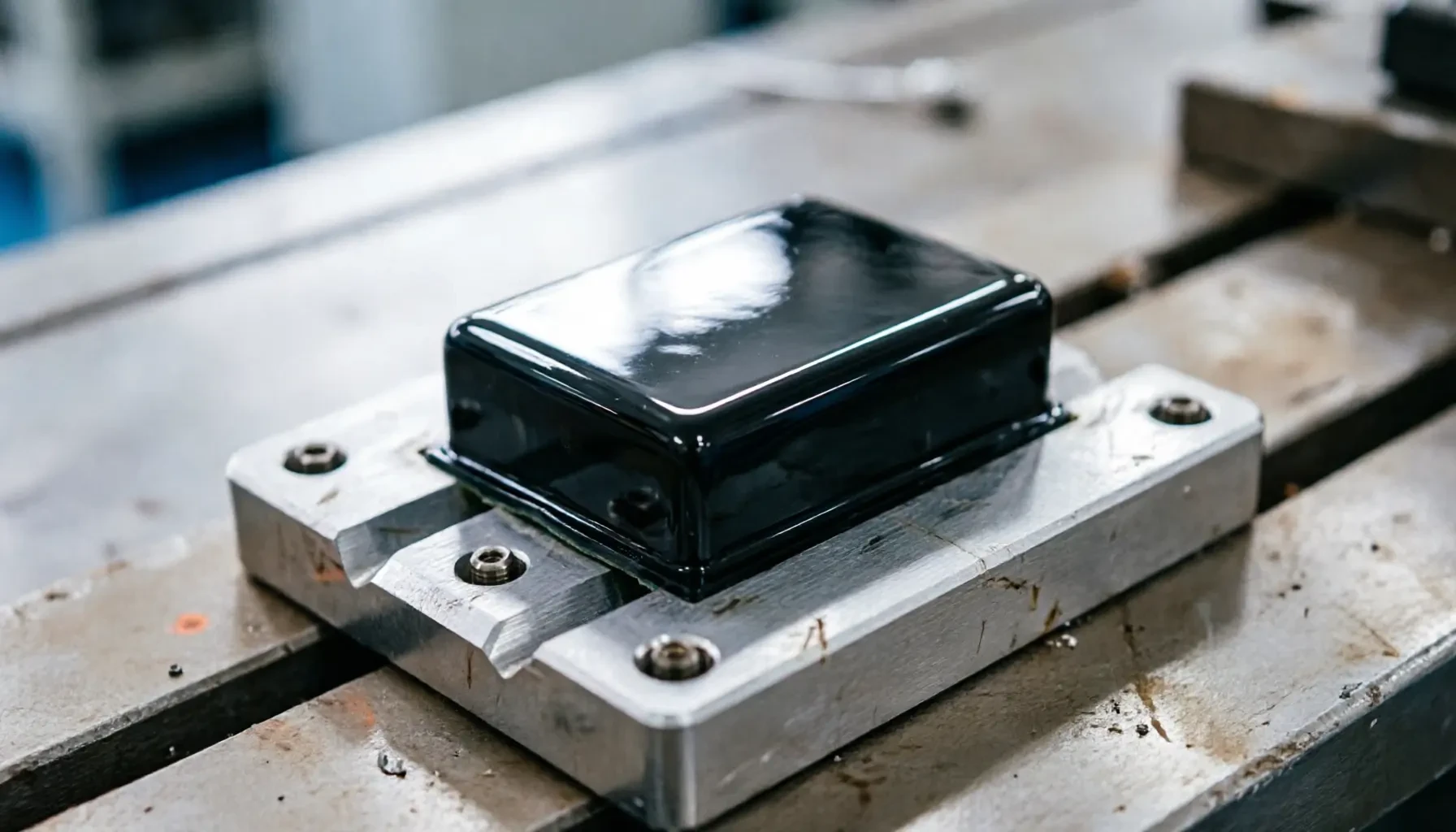
A black control module is usually specified for appearance reasons first and electrical reasons second, and the process consequences of the pigment are discovered afterwards. This note sets out what SEP-988 does to a standard potting system and which parameters have to be re-checked before a production release.
Why Black Potting Is a Process Decision
A 15 percent carbon black paste displaces resin. In a 100 g mixed mass that displacement is enough to change both the time available for wetting and the peak temperature reached in the pot, and both of those change the void content of the cured part. The shade itself is easy; the working window is the part that has to be verified. The reference system used throughout this note is a standard bisphenol-A epoxy with an anhydride hardener, mixed at 25 °C, with SEP-988 epoxy jet black at 15 percent by weight. Values are indicative and should be reproduced on the actual production resin.
The Working Window at 15 Percent Loading
| Parameter | SEP-988 at 15% | Unfilled resin |
|---|---|---|
| Gel time, 100 g at 25 °C | 40–70 min | 25–35 min |
| Peak exotherm, 500 g at 25 °C | 60–90 °C | 140–180 °C |
| Mixed viscosity, 25 °C | +15 to +35% | baseline |
| Demould, 20 mm section | 12–18 h | 6–10 h |
The longer gel time is not a defect. Lower reactive mass per unit volume means slower heat build-up, which is what allows a 20 mm section to be poured without a runaway exotherm in the centre. The cost is that the window for wetting a dense assembly becomes longer but not unlimited: the paste still thickens, and a module that is potted at the end of the gel window will trap air in the gaps between components.
Wetting Small Geometries
The failure mode in black potting is rarely a colour problem. It is a dry joint: paste that bridged across a component instead of flowing under it. Carbon black raises viscosity at a given shear rate more than an equivalent volume of silica, because the primary particles are finer and the structure is more developed. Three measures close most of that gap:
- Condition the paste to 20–25 °C before mixing, so the base viscosity is at its lowest usable point.
- Mix under vacuum rather than de-gassing after pour, so air is removed before the paste reaches the fine gaps.
- Pour from one point and let the level rise, instead of distributing paste across the cavity with a stick.
Voids and Dielectric Margin
A void is a region of low permittivity inside the insulation. At the field strengths used in control and power modules, that discontinuity is where partial discharge starts, and it is where a dielectric test will fail even when the bulk material is correct.
| Void source | Typical cause in black systems | Control |
|---|---|---|
| Entrained during mixing | High viscosity at low temperature | Condition paste, mix under vacuum |
| Trapped under components | Pour at end of gel window | Pour early, single-point fill |
| Shrinkage voids in thick sections | Exotherm gradient | Control section thickness and mass |
| Surface pinholes | Moisture on the board | Bake and dry assemblies before potting |
Void content should be checked by cross-section on the first three production lots, not by visual inspection of the surface. Surface pinholes and internal voids have different causes and different fixes.
Process Window Summary
- Re-qualify gel time and demould time on the production resin, not on the datasheet reference.
- Keep the mixed mass per pot below the point where exotherm exceeds the component rating.
- Treat viscosity rise as the real working limit, and pour early rather than fast.
- Verify void content by cross-section before releasing the part.
For the electrical background on filled encapsulants, see the guide to epoxy potting and casting.