Black Dispersion in Carbon Fibre Tooling: Hiding the Weave Without Hiding the Defect
Tooling gel coats and filled bodies need a black that hides the laminate without hiding surface defects. Dispersion quality decides which one you get.
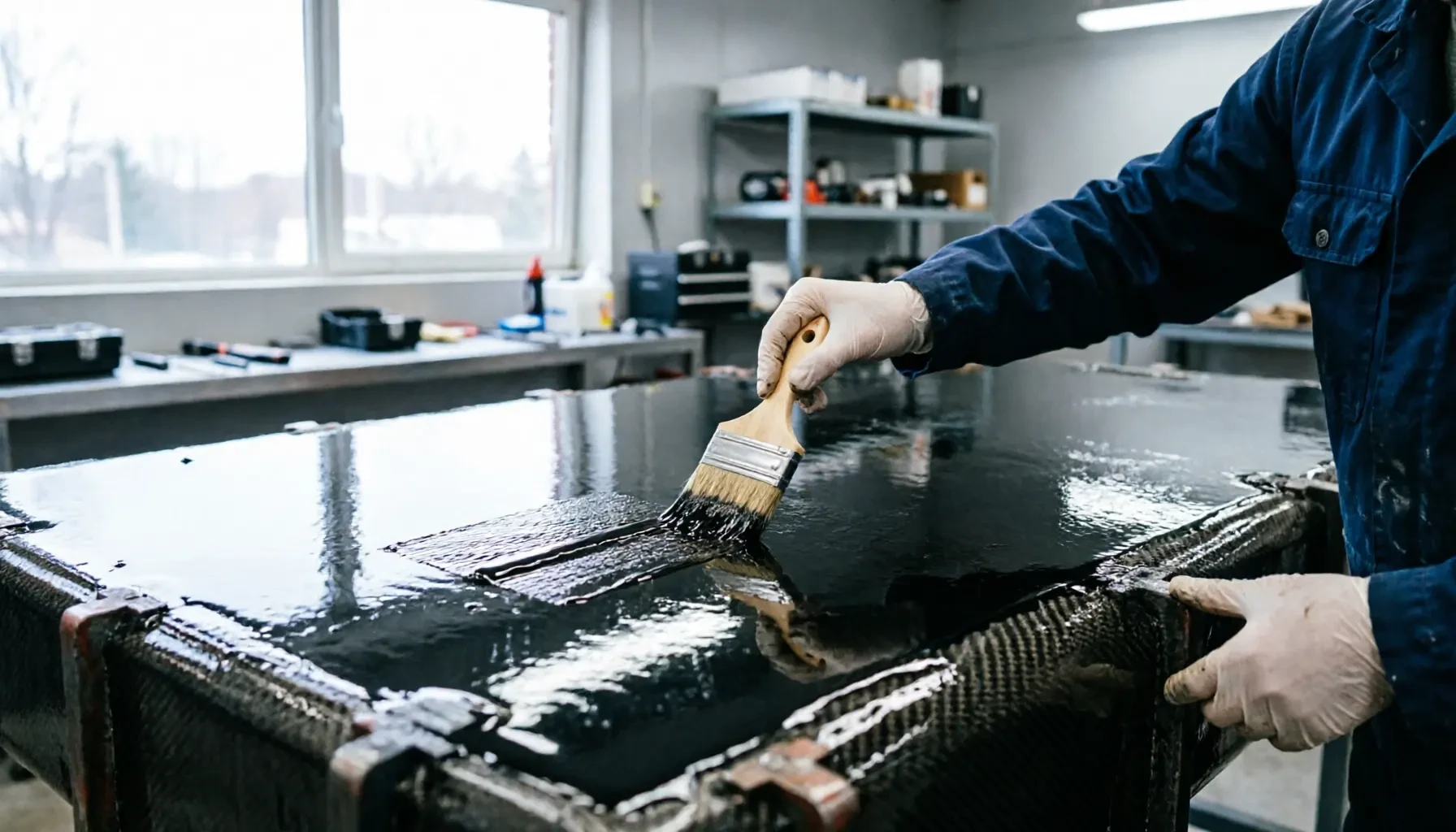
Carbon fibre tooling is black already, so the reason to add a black paste is not colour. It is surface control: a uniform black gel coat or filled body that hides the weave, shows up defects under inspection light, and survives the cure cycles the tool will see.
Why Tooling Black Is Different from Cosmetic Black
A cosmetic black is judged on appearance in daylight. A tooling black is judged on what it reveals under a raking inspection lamp, and on whether it stays uniform after repeated heat cycles. Those are different requirements, and the second one is where dispersion quality matters more than jetness. Poorly dispersed carbon black produces two defects at once: visible specks or streaks, and local areas of lower hiding where the laminate reads through. Both appear only after polishing, which is the most expensive place to find them.
Dispersion, Jetness and Weave Read-Through
Hiding power in a black comes from the number of light-absorbing particles per unit volume and how evenly they are spaced. A 15 percent paste with a tight particle size distribution hides at a lower film build than a 10 percent paste with agglomerates, because the agglomerates contribute colour without contributing hiding.
| Requirement | What it depends on | What to check |
|---|---|---|
| Hiding at 0.5–1.0 mm | Pigment content and dispersion | Drawdown on a contrast card |
| Absence of specks | Filtration and milling | Polished sample under raking light |
| Uniform jetness | Particle size distribution | L* at three points per panel |
| Cure compatibility | Carrier resin | Gel time and hardness on the tool resin |
Gel Coat Versus Filled Body
The same paste is used at very different loadings in the two layers, and the consequences differ accordingly.
| Layer | Typical loading | Main risk |
|---|---|---|
| Gel coat | 5–10% | Streaks and orange peel at the surface |
| Filled body | 10–20% | Exotherm and viscosity rise in thick sections |
| Surface repair | 15–20% | Colour mismatch against the original gel coat |
In a gel coat the paste has to be dispersed into a low-viscosity system without introducing air; in a filled body the same paste competes with filler for wetting. Both are solved by adding the paste before the filler and mixing under vacuum.
Defect Visibility
A black tool surface is chosen partly because it shows defects. That only works if the black itself is uniform.
- Polish a trial panel before approving a batch; specks that are invisible in the wet film appear after polishing.
- Inspect under a raking lamp at 30° to 45°, not under diffuse light.
- Compare L* between the gel coat and any repair paste, because a mismatch shows as a patch after the first cure cycle.
- Check hardness development on the actual tool resin, since a pigment paste changes the exotherm of a thick laminate.
Related Reading
Material data is on the SEP-988 page. For the composite side of the business, see carbon fibre composites.